


~11 min read
Erikka J is an Emmy award-winning Black female voice actor based in Atlanta. She is the audio description narrator for JAŸ-Z In 8, the HBO documentary series featuring the acclaimed rapper alongside famed music producer Rick Rubin. This post explains how a lifetime in hip-hop, and one mentor’s red pen, prepared her for the job.
My first. In 8.
Eight lines for each of the eight episodes is roughly how much copy I recorded as the audio description narrator for HBO’s new music documentary, JAŸ-Z In 8…my first audio description job.
The documentary series premiered September 18th, 2026 and features Rick Rubin sitting with Jay-Z to listen through and discuss selections from his vast catalog as he celebrates 30 years of making music. Eight episodes sans fast cuts, B-roll, or talking heads – just two people and the music sitting in a beautifully simple setting.
HBO selected me to narrate the audio description, produced by Burbank-based post production house Point.360. AD is the audio track that makes film and TV accessible to blind and low-vision viewers.
Honed to Be Heard, Built to Be Found
In a music documentary, the describer’s job is mostly to stay out of the way. The music, and discussion around the stories behind that music, is what carries the narrative. My voice fills the gaps the eyes would normally catch.
Serving the blind and low-vision community is an honor on its own, especially since I’d had experience with Section 508 compliance back in my federal government project management days, and my husband has sickle cell disease type SC, which is notorious for its effect on the eyes.
Narrating a project about an art form I love, built around one of the greatest hip-hop writers of my lifetime, is something else. Plus, this project gifted me with eight takes (once per episode) to say four words I’ll never get tired of saying: “Performed by Erikka J.”

The part that makes me especially giddy (*nerd alert*) is that Point.360/HBO found me through a Google search for the term “black voice actor.” I’ve been studying and working on my SEO/GEO presence after a three month development process (and four year search for the right design partner) to overhaul my website. Marketing is all about presenting yourself as the right solution for a problem a buyer is experiencing at the right time, and I was super excited to see my indirect marketing strategy was paying off. (Steps away from ADHD-fueled ‘nerd-out-on-SEO-and-GEO’ rabbit hole).
Anywho, back to how they found me. After they reached out, I sent them my TV and documentary narration demo, which includes a spot for a music documentary about Nas’ classic rap debut, Illmatic, with the timeless cut “N.Y. State of Mind” playing underneath…an intentional choice. I told my demo producer exactly what I wanted that spot on the demo to showcase through that song selection. Years later, the right client heard it right when they needed someone like me and handed me a Jay-Z series. You can’t script that. Welllll…actually…apparently you can.
The Nas Girl Who Danced to Jay-Z
I grew up on 90s hip-hop…the golden age…the Tupac and Biggie era. I was in college when “Takeover” and “Ether” turned the Jay-Z and Nas rivalry into the defining rap beef of my generation. I picked a side. Loudly. I argued with my friends that Jay-Z, brilliant as he was, couldn’t touch Nas on lyrics. To my college ears, Jay made party music. Nas made poetry.
Take this excerpt from “Made You Look.”

“yall appointed me to bring rap justice, but it aint five-0 yall know its Nas yo”
Clever word play with the justice/five 0 (slang for police) payoff. One bar, two meanings…cultural code compressed into rhyme.
Or the way he reframes “raise your right hand,” later in the verse:
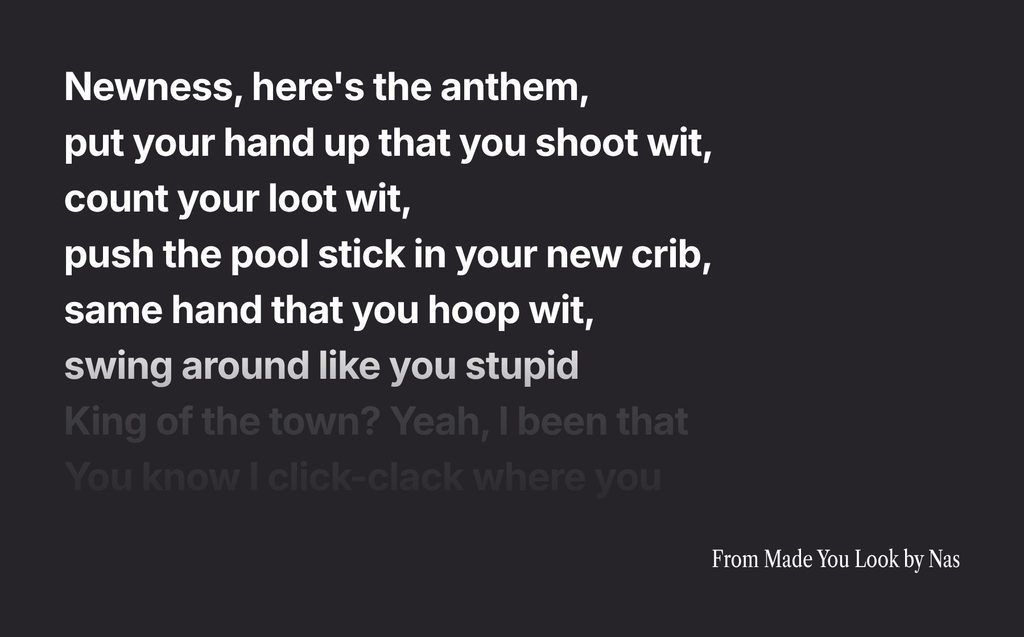
“Newness, here’s the anthem, put your hand up that you shoot wit, count your loot wit, push the pool stick in your new crib, same hand that you hoop wit, swing around like you stupid.”
He took a courtroom formality and rebuilt it in the language of the block – using that whole sentence to speak to black culture instead of simply saying “raise your right hand”. It’s curated craft, poetic lyricism and damn fine writing.
Meanwhile I was still dancing to Jay-Z in the clubs. Both things were true.
What My 40s Taught Me About the Beef
Age changed my perception. Jay-Z’s verse on “What It Feels Like,” his track with the late Nipsey Hussle from 2021’s Judas and the Black Messiah soundtrack, is one of my favorite pieces of writing in recent hip-hop. Flawless execution front to back, and a reminder that hip-hop in politics doesn’t have to sacrifice wordplay to deliver a powerful message. Starting at the 1:26 mark of the song, he moves from the January 6 Capitol attack to Fred Hampton’s assassination to Nipsey’s murder without ever losing the pocket.
“…you know they hate when you become more than they expect. You let them c**ckers storm your capitol, put they feet up on your desk…and yet you talkin’ tough to me, I lost all my little respect, I’m sellin’ weed, in the open, bringin’ folks home from the feds, I know that payback’s gon’ be mean, I’m savin’ all my little bread. Pray for me yall, one day imma have to pay for these thoughts…real n**gas is extinct, it aint safe for me my dawg…they killin’ n**gas in they own hoods, that make sense to you at all”
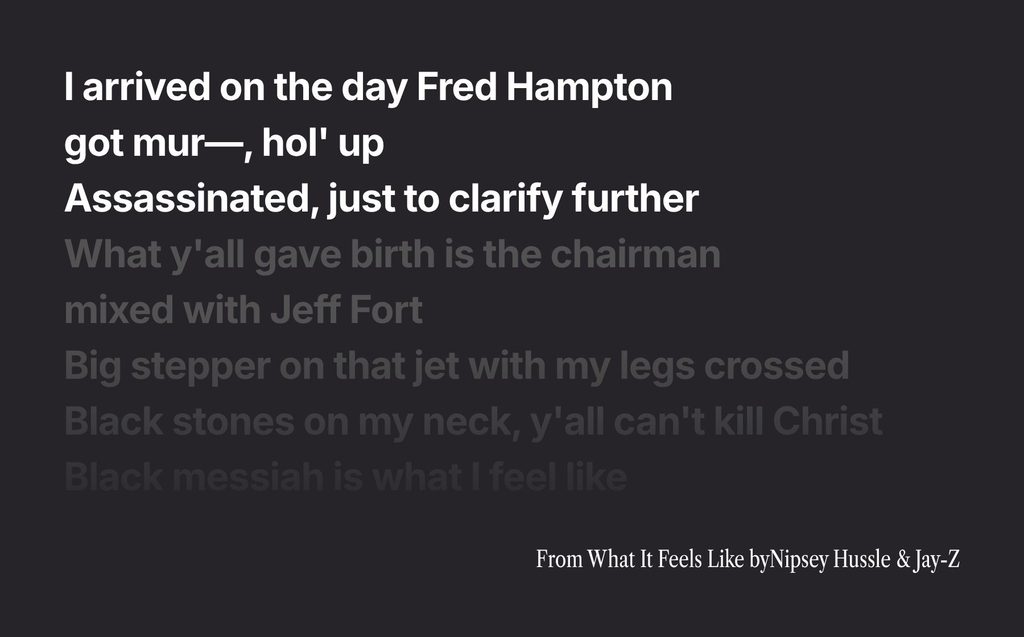
and later in the verse: “I arrived on the day Fred Hampton got mur- hol’ up, assassinated just to clarify further” Then, the verse ends with: “…sh*t aint gon stop cause yall spilled blood, we gon’ turn up even more since yall killed cuz.” cleverly incorporating West Coast hip-hop vernacular in tribute to Nipsey, LA born and bred, who was murdered there in 2019. Rest in peace Nip.
The language is raw – slurs, curse words and all. Coming from men who grew up in some of the most dangerous housing projects in America, that language is honest. And what good is art if it isn’t honest? Or as Nina Simone famously said, “An artist’s duty, as far as I’m concerned, is to reflect the times.”
I no longer need to pick a side. As Rick Rubin pointed out in his recent Diary of a CEO podcast interview (another FANTASTIC watch that I HIGHLY recommend) I now can see that these two artists are incomparable. One isn’t better than the other, they are just different. His book, The Creative Act: A Way of Being has been sitting on my read list for a couple years. I started it right after watching this interview. Here’s insightful another clip from Rubin’s DOAC appearance on why he made the Jay-Z documentary.
Jay-Z and Nas are both impeccable lyricists, though wired differently, and I have immense respect for how each of their minds works. Watching Black men from street backgrounds grow older on record, rapping about wealth, fatherhood, and spiritual growth instead of survival, is one of my favorite things about this era of hip-hop.
Nas went from writing “Ether” to being an early Coinbase investor. Fans joked that maybe Ether stood for Ethereum all along. Street hustle matured into tech money, and the culture matured with it.
Vulnerability Behind the Vernacular
Jay-Z went from writing the full on verbal assault “Takeover,” to putting emotional vulnerability on wax.
Chapter Three of the doc seemed to have a theme of vulnerability, digging into the backstories of tracks from “You Must Love Me” to “This Can’t Be Life,” but it also held a specific, tender moment that touched me.
As Jay and Rick listen back to “4:44,” the album’s title track where he apologizes to his wife, Beyoncé, he nervously laughs, sips his drink, and appears to attempt to settle himself as the intro soulfully sings, “Why do I keep on running away?” He appears to blink away tears as he bops his head to the beat, and the backdrop to the lyrics on screen shifts from him on camera to all black. After the picture fades back in to Jay and Rick while the next verse plays, they continue the listening session with Rick asking Jay for a hug while they exchange a laugh.
After the song ends, Jay tells Rick that listening to that song was hard…that he actually hadn’t heard it since he recorded it. How a lack of both emotional intelligence and experience with healthy relationships led to his fear of vulnerability. A Gen X Black man, one of the most powerful in music, sitting in that vulnerability for the world to witness, was beautiful to watch.
Hip-hop has been one of the few places Black men could be that open, in their own vernacular, and I believe the art form is genuinely cathartic, for both the writer and the listener. I fell in love with hip-hop while living through a tough point in my childhood because it helped me feel that I wasn’t living this story in solitude. Hip-hop’s rhythm draws us in and gives us a canvas. The words tell the stories that move our hearts.
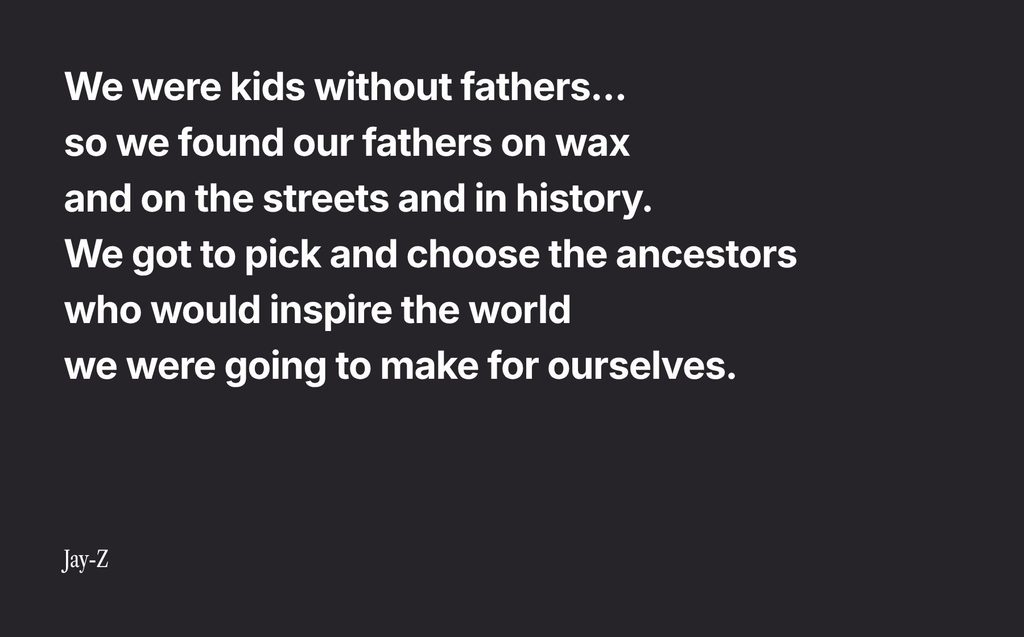
I recently reread one of my favorite books, Steal Like An Artist by Austin Kleon. In the first chapter he quotes Jay-Z as saying “We were kids without fathers…so we found our fathers on wax and on the streets and in history. We got to pick and choose the ancestors who would inspire the world we were going to make for ourselves.” Fitting to come across that right as this doc was released, where he’s explaining the stories that inspired his writings. Hip-hop had already taught me that you’re the sum of everything you absorb long before a book did.
“You Write Like a Rapper”
My songwriting mentor was Kleph Dollaz, one half of the 90s hip-hop duo Ill Biskits, whose shelved Atlantic album Chronicle of Two Losers became a holy grail among underground collectors. “God Bless Your Life” is a deep cut that you should definitely go dig out of the crates. I used it as the intro to the video for my song “Second Family.”
You can go check out the full “God Bless Your Life” track here. You’re welcome.
Kleph heard my early songs and laughed: “You write like a rapper,” going on to explain, “…you’re using too many words,” meaning there was no space for the idea to breathe. “Simplify the hooks,” he told me.
My song “Supposed to Love,” where I sing and rap every self-written lyric, was further proof that the lesson finally clicked. The hook repeats one plain phrase, allowing it to ache. Notice the pronunciation: “sposta,” not “supposed to.”
My grandmother and mother drilled proper grammar into me, and I read everything I could get my hands on as a child, so learning that writing language meant to be sung shouldn’t sound like written English meant to read was a bridge I had to cross.
As a performer, songwriter, and eventually as a voice actor, that is a lesson that has paid dividends. Spoken truth beats correct grammar every time you want art to feel human…which is, well, always.
Kleph unexpectedly passed away in 2012 and I wrote “Second Family” shortly after. Writing that record was cathartic – it helped me work through the pain of that sudden loss.
His sister Trenna Grice founded the God’s Morning Foundation in his memory, a nonprofit that has awarded over $75,000 in scholarships to young people pursuing the arts. I served on its board and still give regularly. If his lessons reached you through this post, consider sending them a tax-deductible donation.
The Retake Nobody Asked For
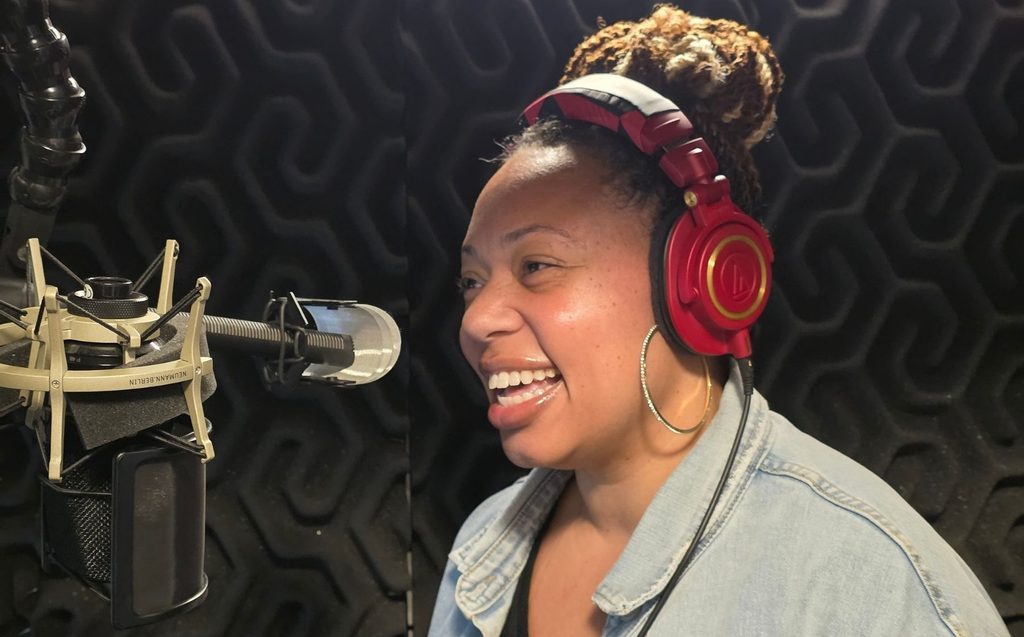
This was my first audio description job, so I did what a careful professional does: I delivered the industry default…calm and subdued. I wanted to supplement the story, not star in it.
Then I watched an episode back with the full sound and heard the problem. My narration was standing politely outside of the music…outside of the culture.
So I asked the producer a question that felt risky: would he mind if I re-recorded with a more hip-hop-influenced delivery? Something in the pocket with a cadence that better matched the world on screen. A more audacious tone with rap’s swagger. He loved the new take and agreed it fit better. We used that tone throughout the rest of the series.
That choice came from everything above. From the early 2000s rap beef-era debates to Kleph’s red pen, from decades of loving this music enough to know how a doc about it should feel to writing my own raps.
That kind of creative partnership is what I love bringing to every voiceover project I work on. My clients aren’t just hiring a voice, they’re hiring a perspective. A world view. A human experience.
Cultural fluency is a craft…a skill earned only through lived experience. It told me the default was wrong before anyone else noticed, and it gave me the vocabulary to correct it.
The Raw, Real Deal Takeaway
Jay-Z says in the series trailer, “The reason why rap is so loved, that feeling of that underdog, that’s why people was listening, that’s why it hit them somewhere…How powerful is this music?”
A Google search found me, but having lived within hip-hop culture is what qualified me.
I love hip-hop. Every era of my life fed this credit: the pre-teen sneaking to watch Tupac’s “I Get Around” video on BET, the middle school girl sitting by the radio to record her favorite songs on cassette then playing and rewinding so she could write down every lyric.
The high school athlete listening to Busta Rhymes’ “Everybody Rise” while warming up for track meets (shout out to VA hip-hop vet producer Nottz), the college kid arguing about “Ether” vs “Takeover,” the songwriter learning to leave space…all led to the narrator who trusted her ear over a default, safe, subdued read.
If you’re producing a documentary and need narration that belongs inside of the story instead of sitting on top of it, hit me up. Hear the demo that booked HBO, then, let’s rap. Pun intended.
JAŸ-Z In 8 is streaming now on HBO Max. Turn on the audio description option to listen out for a familiar voice.
FAQ
What is audio description?
Audio description (AD) is a separate narration track that describes key visual elements of a film or show (settings, on-screen text, actions, expressions) for blind and low-vision viewers. The narration is placed in natural pauses so it never talks over dialogue or, in a music documentary, over the music.
Who narrates the audio description for JAŸ-Z In 8?
Erikka J, an Emmy award-winning voice actor based in Atlanta, narrates the audio description for all eight chapters. The AD track was produced by Point.360 for HBO.
How much narration is in a music documentary’s audio description?
Very little by design. In JAŸ-Z In 8, Erikka J recorded about eight lines for each episode. The music and conversation carry the story, so the narrator’s job is to fill only the gaps a full-sighted viewer would catch, and then get out of the way.
How do I turn on audio description on HBO Max?
Here’s how to turn on audio description in three easy steps:
Step 1: Start the episode
Step 2: Open the audio and subtitles menu from the playback controls
Step 3: Select the English audio description track.
On most devices it’s listed alongside the standard language options.
Can a voice actor ask to re-record a take?
Yes, and the good ones do when they hear a mismatch. A short, specific note to the producer such as, “Would you mind if I try a read that sits closer to the music?” is a creative offer, and it’s how this series ended up with a hip-hop-influenced AD track that complements the story.
Erikka J is an Emmy award-winning Black female voice actor, singer, event emcee, and communications consultant from Washington, D.C., who grew her career in Virginia and is now based in Atlanta. She is the audio description narrator for JAŸ-Z In 8, the HBO documentary series featuring acclaimed rapper Jay-Z alongside famed music producer Rick Rubin. To check availability or request a custom demo, click the Start Your Project button.

